Remediating bed bugs in Bernalillo County requires accounting for Albuquerque's high elevation of 5,312 feet and typical indoor humidity levels below 20 percent. While standalone chemical spray applications often…
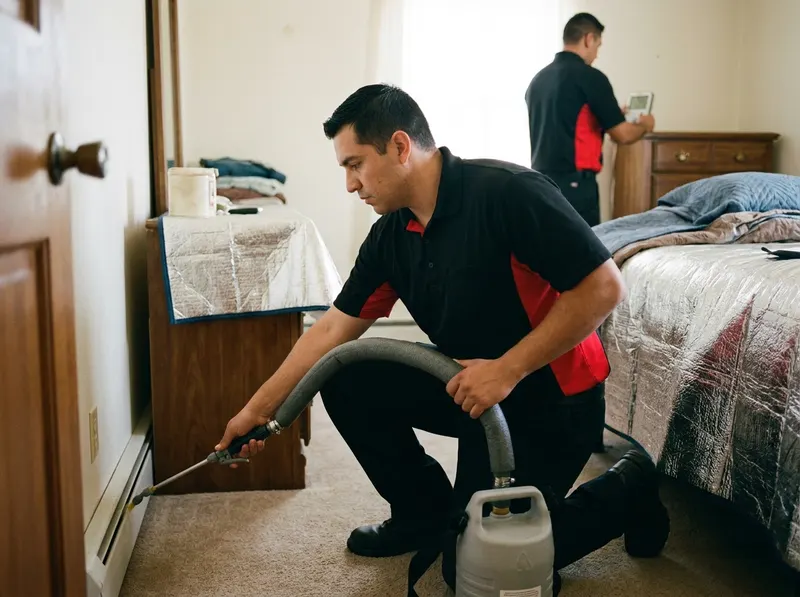
Remediating bed bugs in Bernalillo County requires accounting for Albuquerque's high elevation of 5,312 feet and typical indoor humidity levels below 20 percent. While standalone chemical spray applications often require 3 to 4 visits and fail against pesticide-resistant bed bug populations, thermal remediation elevates ambient room temperatures to lethal levels between 120°F and 135°F. Industrial convective air movers circulate heated air into mattress seams, box springs, baseboards, and deep structural wall cavities. Because adobe, double-brick, and thick lathe-and-plaster construction common in neighborhoods like Barelas, Old Town Albuquerque, and Nob Hill possess substantial thermal mass, heat absorption takes longer than in standard modern drywall framing. Precision thermal monitoring with infrared sensors ensures cold spots are systematically eliminated without damaging household items.
A complete eradication protocol pairs thermal heat with localized long-term residual barriers. As temperatures rise, bed bugs instinctively attempt to flee the heat zone into cooler voids, electrical outlets, or neighboring rooms. Technicians inject long-acting amorphous silica gel dust or botanical pyrethroid formulations into wall plates, baseboard margins, and framing penetrations prior to and immediately following the heat phase. Unlike liquid contact sprays that evaporate rapidly in dry desert air, desiccant dusts remain active for months by stripping the waxy cuticle layer from the insect exoskeleton, causing fatal dehydration should any dormant egg or re-introduced adult cross the barrier. For multi-family properties near Downtown Albuquerque and the University of New Mexico corridor, this secondary barrier stops cross-unit migration through shared plumbing raceways and utility conduits.
Preparing a residence involves clear operational steps to preserve structural and personal property while ensuring thermal penetration. 1. Heat-sensitive items including wax candles, aerosol cans, pressurized cylinders, oil paintings, prescription medications, vinyl records, and fresh groceries are sealed in plastic bins and inspected before removal from the treatment zone. 2. Large furniture pieces, mattress foundations, and dresser drawers are spaced 12 to 18 inches away from exterior walls to permit uninhibited high-velocity airflow. 3. Electronic equipment is unplugged to protect integrated circuitry, while built-in entertainment units undergo non-destructive localized residual vacuuming. 4. High-capacity radial fans operate continuously across North Valley adobe homes and Foothills properties until core probe temperatures register above 122°F for a minimum sustained duration of 90 minutes. 5. Once the structure cools, a technician executes perimeter desiccant dusting and installs passive interception traps beneath bed casters to document ongoing zero-activity metrics.
Every job gets a firm, written price after a free on-site visit.
Tell us about your bed bug heat and residual remediation job in Albuquerque and we'll send a clear, written quote, usually the same day.
 Vexlora Pest Management