Rodent exclusion and proofing provides mechanical defense that chemical baits and snap traps cannot deliver. While toxic baits attempt to manage rodent counts after animals enter a structure, exclusion denies physical…
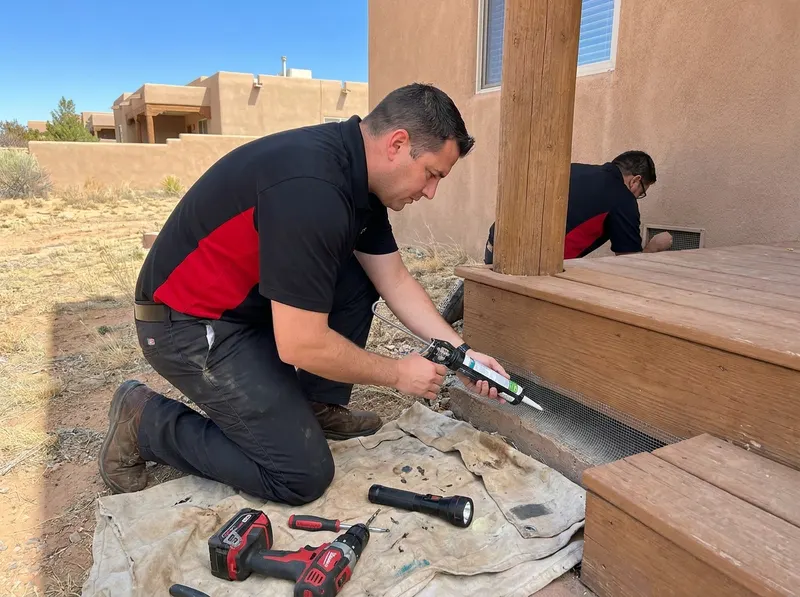
Rodent exclusion and proofing provides mechanical defense that chemical baits and snap traps cannot deliver. While toxic baits attempt to manage rodent counts after animals enter a structure, exclusion denies physical access to crawl spaces, attics, and wall voids entirely. A standard mouse can pass through an aperture measuring one-quarter inch across, while a desert woodrat requires just one-half inch. In high-desert climates, rodents move toward conditioned indoor air and utility water lines during dry summer spells and cold winter freezes. Sealing these vulnerabilities prevents attic insulation contamination, ruined flexible HVAC ducting, and gnawed electrical wiring.
Building construction across Bernalillo County presents distinct structural vulnerabilities that require specialized architectural exclusion methods. In historic adobe properties and mid-century residences in Barelas, South Valley, and Downtown Albuquerque, settling creates voids where mud mortar degrades behind exterior lime or cement stucco washes. In modern multi-story stucco homes across Taylor Ranch, the Westside, and High Desert, the primary failure points occur along the weep screed at the foundation base, roof tile underlayment gaps, and split AC conduit penetrations. Field mechanics secure weep screed perimeters with custom-bent galvanized hardware cloth and fill wall voids with dense metal mesh that teeth cannot shear.
Environmental geography dictates localized rodent pressure across Albuquerque. Properties in the North Valley near the Rio Grande Nature Center State Park face heavy roof rat activity supported by agricultural canals and dense cottonwood canopies. Conversely, properties bordering open public lands along the Foothills, Sandia Peak Tramway corridors, and Petroglyph National Monument encounter severe desert woodrat infestations. These desert pack rats nest inside engine bays, exterior AC condenser enclosures, and unsealed crawlspaces, carrying cholla cactus joints, bone fragments, and dry debris into attics. Structural exclusion stops these species at the exterior wall without dispersing anticoagulants into local raptor and domestic pet food chains.
Executing physical exclusion follows a four-step mechanical procedure: 1. A physical audit from ground level to parapet edge identifies chewed wood trim, displaced vent covers, and rub marks along pipe runs. 2. Technicians clean and sanitize accessible transition voids to remove pheromone trails left by previous pest runs. 3. Installers fasten 19-gauge hot-dipped galvanized mesh over attic vents, crawl space grates, and gable louvers using hardened corrosion-resistant masonry anchors. 4. Gaps surrounding copper refrigerant lines, natural gas pipes, and conduit boxes are packed with industrial copper fill fabric and sealed with heavy-duty elastomeric polyurethane.
Every job gets a firm, written price after a free on-site visit.
Tell us about your rodent exclusion and proofing job in Albuquerque and we'll send a clear, written quote, usually the same day.
 Vexlora Pest Management