Albuquerque's arid climate creates intense seasonal nesting behavior among hymenoptera species between April and October. Western yellowjackets and paper wasps build rapid-growth colonies under south-facing vigas,…
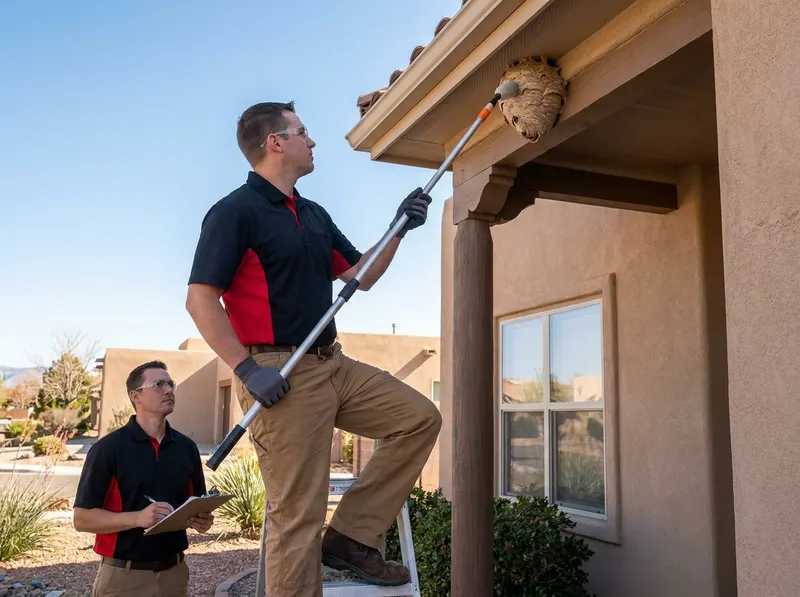
Albuquerque's arid climate creates intense seasonal nesting behavior among hymenoptera species between April and October. Western yellowjackets and paper wasps build rapid-growth colonies under south-facing vigas, behind parapet caps, and inside deep cracks within weathered exterior stucco. Properties near the Rio Grande agricultural corridors in the North Valley and South Valley experience heavy subterranean yellowjacket activity in irrigation ditches and rodent burrows. In foothill zones like High Desert and the Sandia Foothills, aerial bald-faced hornet nests frequently establish in scrub oak, pinon pines, and elevated roof eaves exceeding 18 feet in height.
Wasp and hornet removal replaces consumer aerosol sprays with physical containment and targeted non-repellent microencapsulated formulations. Store-bought chemical sprays disperse defensive worker wasps outward into yards, leaving pupae protected inside closed brood cells to emerge 7 to 10 days later. Professional treatment neutralizes the active adult population, extracts the comb structure, and neutralizes the chemical aggregation pheromone left on wood or adobe surfaces. The trade-off between exterior mechanical removal and structural void injection involves access requirements: exposed nests permit rapid physical removal, whereas colonies positioned behind fascia boards or inside chimney chases necessitate calibrated dust injection without tearing out structural drywall.
Technicians approach stinging insect eradication through four precise operational steps. First, the perimeter inspection identifies the exact species, locating primary nests and secondary satellite colonies across outbuildings, utility boxes, and roof lines. Second, targeted thermal or pressurized micro-dust application disables defensive flying workers and the laying queen. Third, manual pole scrapers or vacuum systems detach the physical nest from the building substrate. Fourth, technicians apply a residual barrier to the anchoring point to prevent returning foragers from reconstructing the colony.
Every job gets a firm, written price after a free on-site visit.
Tell us about your wasp and hornet removal job in Albuquerque and we'll send a clear, written quote, usually the same day.
 Vexlora Pest Management